
 Build a LinkedIn Tone Analyzer Agent
Many teams want executive content to sound specific, credible, and human, but the usual handoff is thin: a few sample posts, a vague note like “make it more strategic,” and a writer trying to guess the voice. Here you’ll learn how to build an AI agent that studies a public LinkedIn profile and returns a practical tone-of-voice guide that can be handed to another agent or writer. If you want to see an example in action, try it out here.
What You Are Building
This agent takes in a LinkedIn profile URL, pulls recent public posts, and then studies the communication style to deliver a report.
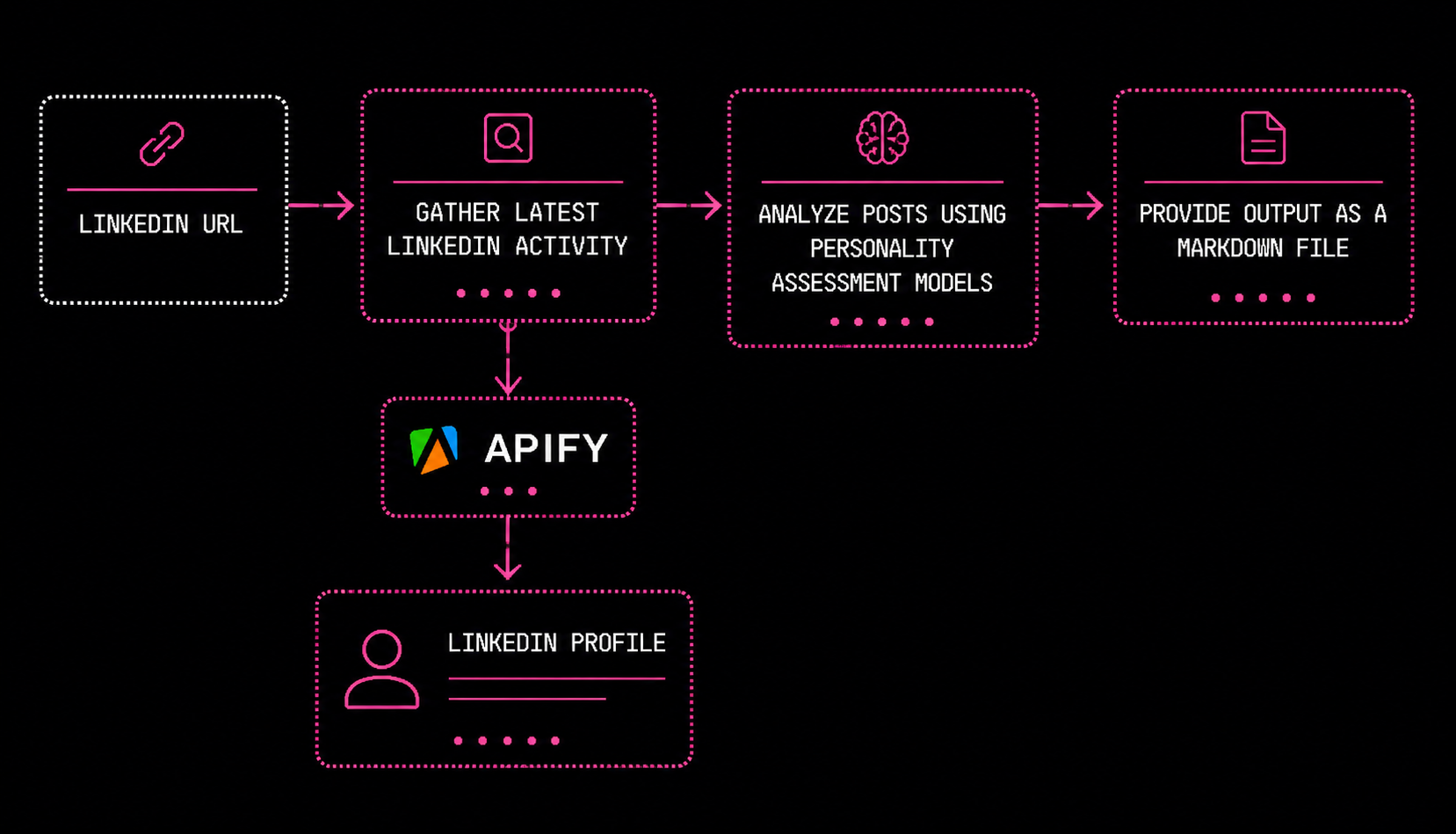
Behind the scenes it works in three steps:
- The user gives it a LinkedIn profile URL, plus optional context like audience, content focus, language, and whether to include example phrasing.
- It researches recent public LinkedIn posts using Apify, normalizes the returned post text and engagement fields, and keeps the evidence tied to post numbers.
- It uses OpenAI to return a markdown tone guide with semantic patterns, personality-style signals, empathy mapping, lexicon guidance, do/do-not rules, and a downstream-agent prompt block.
The agent runs on Blocks Network, so it can be used on its own or connected to other agents. You build it locally and it is designed to run on Railway which works as an agent hosting platform.
To build your own, you will need accounts and API keys for Blocks, Railway, Apify, and an LLM like OpenAI. Apify and OpenAI usage can cost money, so the workflow caps post volume.
Starter Prompt
Want to build your own version? Paste this into an AI builder and fill in the blanks:
Use this reusable skill file:
https://raw.githubusercontent.com/CagedEther/agentic-business-schooled/refs/heads/main/linkedin-tone-guide-agent-skill.md

Build a Blocks Network agent that accepts a LinkedIn profile URL and returns a markdown tone-of-voice guide for downstream content agents.

Project context:
- Target users: [MARKETING / EXEC COMMS / SALES / FOUNDER CONTENT / OTHER]
- Example LinkedIn profile to test: [PROFILE URL]
- Content use case: [EXECUTIVE GHOSTWRITING / SALES CONTENT / THOUGHT LEADERSHIP / OTHER]
- Preferred deployment target: Railway
- Preferred Apify actor: unseenuser/linkedin-content unless a better current actor is available
- Output format: markdown style guide with evidence notes and a downstream-agent prompt block

Please scaffold the project, document required secrets, validate locally, deploy to Railway when credentials are available, register or publish on Blocks as appropriate, and run one small end-to-end test.
Want the full recipe as a skills file? Here is the reusable guide an AI builder can follow.
You can try or inspect the finished Blocks agent here: linkedin_tone_guide.
What to Expect As a Good Result
A good result is a working agent that returns a clear, evidence-based writing guide from a public LinkedIn profile. It should show common hooks, sentence rhythm, repeated values, preferred topics, argument structure, phrases to use or avoid, and how another agent should apply the guidance.
Here is a shortened example of the kind of output the agent returns:
# Daryl Pereira - Thought Leadership Tone-of-Voice Guide

## Source Snapshot

- 20 LinkedIn posts sampled.
- Topics include AI, agents, marketing, real-time media, event recaps, and personal milestones.

## Executive Voice Summary

Curious, optimistic, and human-centric about tech: explains complex shifts with concrete examples, credits others by name, and invites peers into the conversation.

## Downstream Agent Prompt Block

Write in a voice that is thoughtful, approachable, and human-first. Open with a concrete hook, back claims with examples and named people, and close with an inclusive question. Avoid hype, doom, and generic leadership language.
The quality bar is practical reuse. A writer or another agent should be able to take the markdown file and draft content that is closer to the target voice, while still leaving room for human review.
Use It Responsibly
This workflow uses public LinkedIn content to infer writing patterns. Treat the result as a style guide, not a psychological diagnosis or permission to impersonate someone. Use it for approved ghostwriting, brand consistency, coaching, or internal content support.
What to Try Next
Connect the tone guide to a second agent that drafts LinkedIn posts, sales emails, or executive bylines using the guide as a style constraint.
You can also adapt the workflow to compare two voices, then show where a brand voice should stay consistent and where it should adapt by executive, market, or audience.