
 Build a LinkedIn Topic Ideas Agent
If ever you want to research a business topic and find out what people are saying about it, LinkedIn is a great place to start. In this case we’ll build an AI agent that researches the topic and then presents content ideas. The agent acts like a research assistant: give it a topic, and it brings back themes, pain points, post examples, and content angles your team can review.
It is useful when a business wants content strategy grounded in real market conversation instead of generic brainstorms.
Want the full recipe? Here is the reusable guide an AI builder can follow.
You can also try the finished agent for yourself here.
What You Are Building
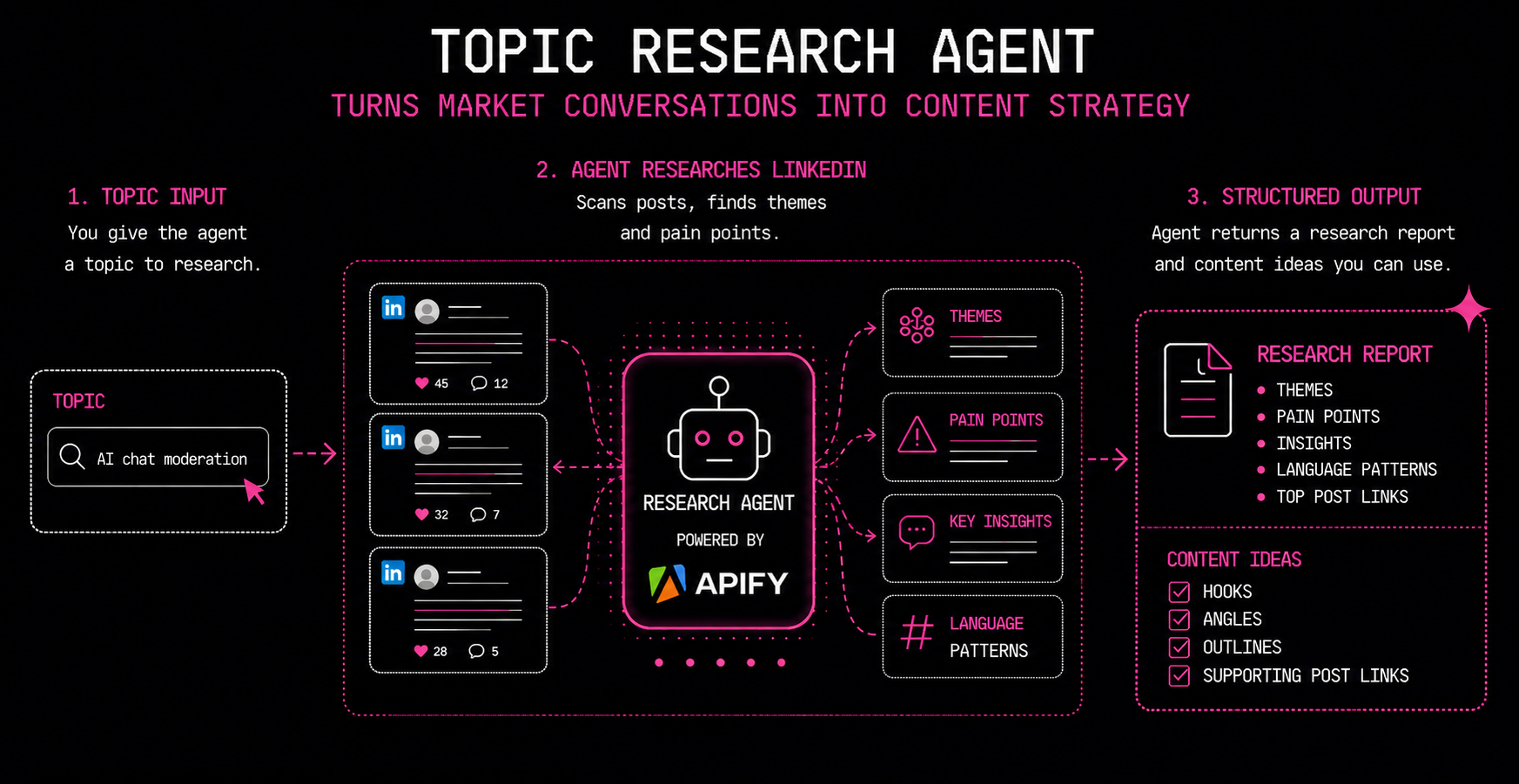
You are building a topic research assistant for marketing, product marketing, founder-led sales, or thought leadership. Give it a topic like home solar power and it does the work a junior researcher would take a day to do: it scans recent LinkedIn posts on that topic, identifies the themes, pain points, and language the market is actually using, then hands back a research report plus ready-to-use content ideas with hooks, angles, outlines, and links to the supporting posts.
Behind the scenes it works in three steps:
- You give it a topic. Optionally add your target audience and brand context so the output fits your positioning.
- It researches LinkedIn. The agent gathers real post data (via Apify) and looks for recurring themes, pain points, key insights, and language patterns — evidence, not guesses.
- It returns structured output. An AI model (OpenAI) turns that evidence into a research report and a set of content ideas your team can review, prioritize, and write from.
The agent runs on Blocks Network, so it can be used on its own or connected to other agents — for example, one agent researches the market conversation, another drafts the LinkedIn posts, and another adapts them to a specific executive voice. It is hosted on Railway so it stays online like any other business service.
To build it you need accounts and API keys for Blocks, Railway, Apify, and OpenAI. Apify and OpenAI usage costs money, so the reference workflow caps research volume to keep test runs affordable.
The business value is simple: before you write, you can see how the market is already talking.
Starter Prompt
Want to build your own version? Paste this into an AI builder and fill in the blanks:
Use this reusable skill file:
https://raw.githubusercontent.com/CagedEther/agentic-business-schooled/refs/heads/main/linkedin-topic-content-ideas-agent-skill.md

Build a Blocks Network agent that researches LinkedIn discussion for a topic and returns content ideas.

Project context:
- Topic workflow: [DESCRIBE YOUR CONTENT OR RESEARCH NEED]
- Target audience: [AUDIENCE]
- Brand or market context: [BRAND CONTEXT]
- Preferred LinkedIn actor: harvestapi/linkedin-post-search unless there is a better current actor
- Deployment target: Railway

Please scaffold the project, document the required secrets, validate locally, deploy to Railway, register privately on Blocks, and run one small end-to-end test.
What to Expect As a Good Result
A good result is a working agent your team can rely on: it stays online, responds to any topic you give it, and returns a readable research report covering discussion themes, pain points, common frames, white space, and evidence highlights, along with structured content ideas complete with titles, hooks, formats, outlines, and supporting LinkedIn links. Research and AI costs stay controlled so running it regularly is affordable, and because it is registered on Blocks, other agents and workflows can call it.
Here is a truncated example of the report the agent returns for the topic home solar power:
# LinkedIn Topic Content Ideas

- Topic: home solar power
- Normalized posts: 120

## Discussion Summary

**How the topic shows up:**
- home solar power is showing up through practical lessons, market
  observations, and opinionated operating advice.

**Common frames:**
- question-led hooks (26 sampled posts)
- contrarian posts that challenge a familiar assumption (8 sampled posts)
- frameworks, checklists, and playbooks (5 sampled posts)

**White space:**
- A strong opening is to connect home solar power to a specific decision,
  failure mode, or buyer/customer moment.

## Content Ideas

### The hidden constraint behind home solar power

**Hook:** Everyone is talking about home solar power. Fewer people are
talking about the constraint that decides whether it actually works.

**Angle:** Turn the topic into a practical tradeoff: what sounds easy,
what breaks, and what teams should inspect first.

**Format:** Contrarian point of view

**Outline:**
- Name the popular assumption.
- Show the overlooked constraint.
- Give a short decision rule.
- Close with a question for operators.

**Supporting posts:**
- https://www.linkedin.com/posts/...

### A practical checklist for home solar power

**Hook:** If I were evaluating home solar power this week, I would start
with these questions.

...plus 8 more content ideas, evidence highlights with links to the
top-ranked posts, and pattern signals from the research.
What to Try Next
The advantage of creating this as an agent is that it can be easily hooked up to other agents, for instance to take content ideas and feed this into another agent that builds a marketing plan.
You can also adapt the workflow so it compares two topics side by side, such as home solar power versus home battery storage, then asks the agent to identify positioning gaps and content opportunities.